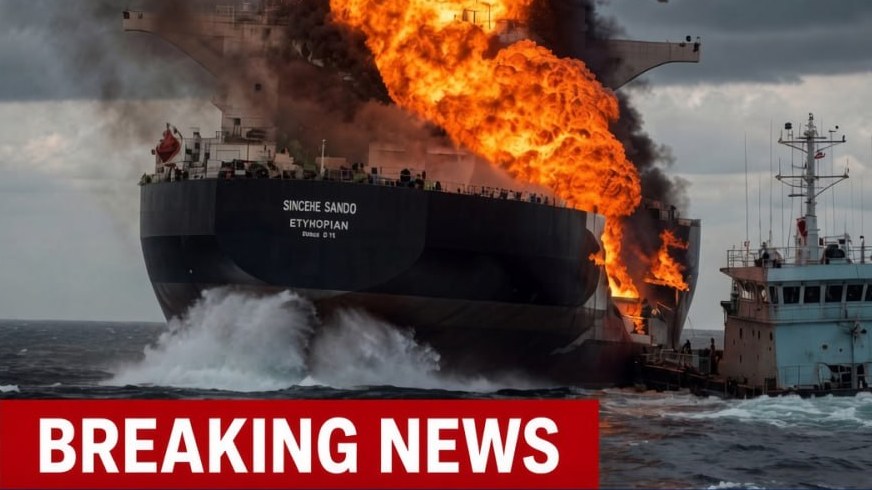
WASHINGTON — Social media claims alleging that the U.S. Navy intercepted an Iranian cargo vessel in the Gulf of Oman have circulated widely online, but there is currently no official confirmation of the reported confrontation.
The posts describe an alleged six-hour encounter involving the guided-missile destroyer USS
Spruance and an Iranian-flagged commercial vessel near the Strait of Hormuz. According to the viral accounts, the ship allegedly ignored repeated warnings before American forces opened fire and disabled the vessel.
However, no publicly available statement from the U.S. Navy or Department of Defense has confirmed that such an engagement took place.
What the Viral Posts Claim
The online reports provide a detailed account of an alleged confrontation.
According to the claims, the Iranian vessel repeatedly refused instructions from the American warship during an encounter that reportedly lasted approximately six hours. The posts allege that the USS Spruance eventually fired its 5-inch naval gun, striking the vessel’s engine room and disabling the ship.
The accounts further claim that U.S. Marines boarded the vessel after it was disabled and took control without encountering significant resistance.
Some versions of the story portray the alleged operation as a deliberate enforcement action authorized by the Trump administration and claim that the vessel remains under American custody.
Despite the specificity of these claims, no supporting evidence has been publicly established.
No Official Confirmation
The most significant issue surrounding the story is the absence of confirmation
from authoritative sources.
Neither the U.S. Navy nor the Department of Defense has publicly announced an operation matching the description circulating online. There has also been no verified military statement identifying an Iranian cargo ship as having been seized or disabled during such an encounter.
Likewise, publicly available maritime information cited in the supplied account does not independently establish that the alleged incident occurred.
That lack of evidence does not, by itself, prove that no encounter took place. Military operations can sometimes remain classified or undisclosed for security reasons. But without credible documentation or official confirmation, the specific claims circulating online cannot responsibly be presented as established fact.
Why the Story Is Gaining Attention
The alleged incident has attracted attention because of the strategic importance of the Gulf of Oman and the Strait of Hormuz, one of the world’s most important maritime routes.
Any confirmed confrontation involving an American warship and an Iranian commercial vessel could have significant diplomatic and military consequences, particularly amid heightened tensions between Washington and Tehran.
That is precisely why unverified reports involving military forces can be especially
dangerous. False or exaggerated claims can spread rapidly, influence public perception and potentially contribute to fears of a broader confrontation.
Verification Remains Essential
The incident serves as another reminder of the challenges surrounding breaking news in the social-media era.
Detailed descriptions, dramatic videos and confident claims can create the impression that an event has been independently established when it has not. Readers should look for confirmation from military authorities, established maritime-monitoring organizations and reputable news outlets before accepting such reports as fact.
For now, the alleged interception of the Iranian cargo ship remains unconfirmed.
Until credible evidence emerges, the claims should be treated as social-media allegations rather than verified military reporting.