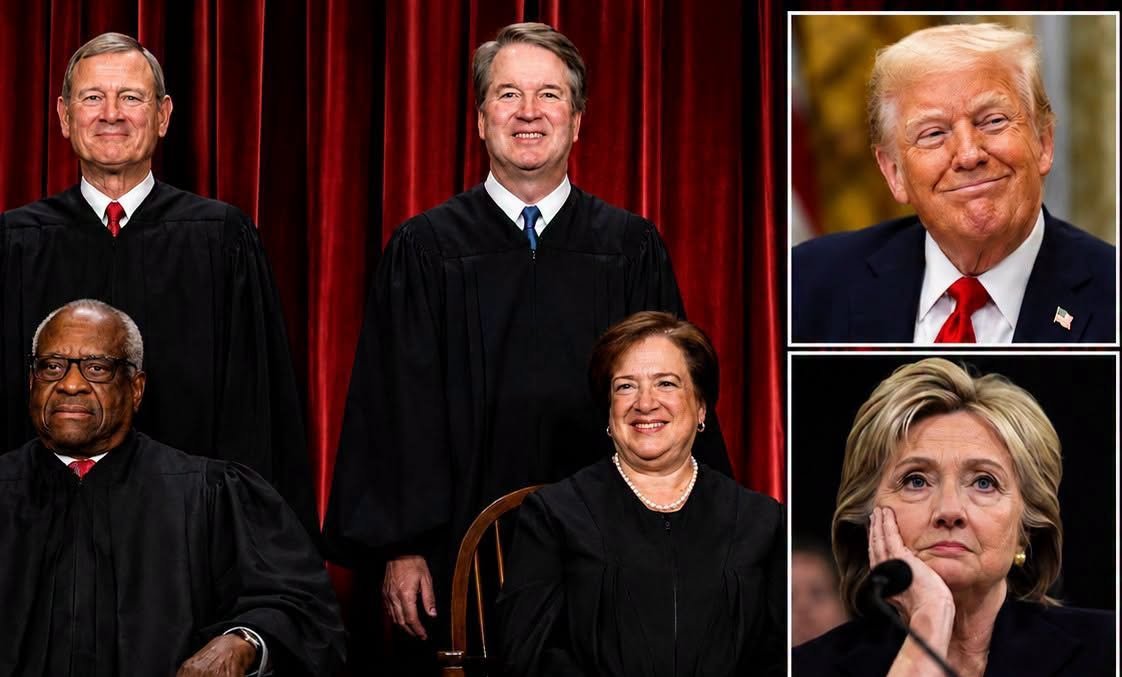
Although they were once friends, President Donald Trump and former First Lady Hillary Clinton have been emotionally at odds with one another since the 2016 election.
Their dispute is now on the verge of reaching the highest court
in the country.
By requesting the U.S. Supreme Court to review a lower court decision that rejected his civil conspiracy claims and imposed sanctions of almost $1 million, Trump is carrying on his protracted legal battle against Clinton.
Trump’s request for more time to submit a petition asking the Supreme Court to hear the case was granted this week by Justice Clarence Thomas.
Trump’s petition in Trump v. Clinton, which is based on accusations that Clinton and others supported claims that Trump’s 2016 presidential campaign colluded with Russia, must now be submitted by September 9.
An opinion on the case’s merits is not reflected in the extension, which is a standard procedural action.
Thomas manages administrative requests, including filing extensions, as the justice assigned to cases originating from the pertinent federal circuit.
Only after the petition is filed will the Supreme Court decide whether to hear the appeal; before the case can move forward, at least four justices must vote in favor of review.
On July 23, Trump’s legal team submitted the request for an extension to the Supreme Court.
His attorneys contended in it that the upcoming petition will bring up “exceptionally important” issues and that the sanctions order and appellate decision “carries with it profound impact on the Presidency, and the nation as a whole.”
It is anticipated that Trump’s appeal will address both the more general legal question of when courts may impose sanctions against a president and his lawyers for filing civil litigation, as well as the underlying allegations surrounding the Russia investigation.
Many of the legal arguments put forth by Trump and his lawyer, Alina Habba, were found to be without merit by the federal appeals court that reviewed the case, which harshly condemned the lawsuit.
The court maintained the nearly $1 million in fines imposed on Trump, Habba, and her New Jersey-based legal practice.
Trump’s appeal is anticipated to address both the underlying lawsuit and the
wider authority of courts to impose substantial sanctions on litigants whose claims are found to lack legal merit. The sanctions amount to a substantial financial penalty.
In his initial complaint, Trump claimed that Hillary Clinton and others worked together to spread a false narrative that connected Russian election meddling to his 2016 presidential campaign.
The federal appeals court affirmed the district court’s decision to reject those claims. The specific appellate circuit that rendered the decision was not mentioned in the filing requesting more time to petition the Supreme Court.
Trump is currently requesting that the Supreme Court consider a number of cases, including the Clinton lawsuit.
Thomas also gave Trump more time to submit his petition in a different defamation lawsuit against CNN for using the term “big lie” to characterize Trump’s claims about the 2020 election. The deadline for that filing is August 14.
In the E. Jean Carroll case, Trump is also pursuing his legal challenge.
He filed a petition for rehearing on July 8, requesting the justices to reconsider the damages award entered against him after the Supreme Court rejected his initial appeal last month. In an uncommon move, the high court granted his request.
The three petitions collectively present the court with a number of Trump-related legal disputes, each involving unique legal issues ranging from civil liability to sanctions and defamation.
Regarding the Supreme Court’s ruling to give Trump more time to submit his petition, Clinton has remained silent.
Despite being named as a defendant in the case, there is no indication in the court documents that she took any independent action regarding the request for an extension.
The court documents that are currently accessible do not name the other defendants mentioned in Trump’s initial complaint.
Trump’s long-standing claim that accusations connecting his 2016 presidential campaign to Russian election meddling were intentionally spread through false or deceptive claims is the basis for the lawsuit.