“The father married his daughter, who had been blind since birth, to a beggar — and what happened next shocked many people.” Zainab had never seen the world, but she could sense its cruelty with every breath she took.
She was born blind into a family that prized beauty above everything
else. Her two sisters were praised for their beautiful eyes and graceful figures, while Zainab was seen as a burden — a shameful secret kept behind closed doors. Her mother died when she was just five years old, and from that moment forward, her father changed.
He became bitter, resentful, and heartless — especially toward her. He never called her by name.
He called her “that thing.” He didn’t want her at the table during family meals, or outside when guests came over. He believed she was cursed, and when she turned twenty-one, he made a choice that would destroy what little remained of her already broken heart. One morning, he walked into her small room where she sat quietly, tracing her fingers over the worn pages of a Braille book, and tossed a folded piece of fabric onto her lap.
“You’re getting married tomorrow,” he said coldly. She froze. The words didn’t make sense.
Married? To whom? “He’s a beggar from the mosque,” her father continued.
“You’re blind. He’s poor. A perfect pair.”
She felt the blood leave her face. She wanted to scream, but
no sound escaped. She had no choice.
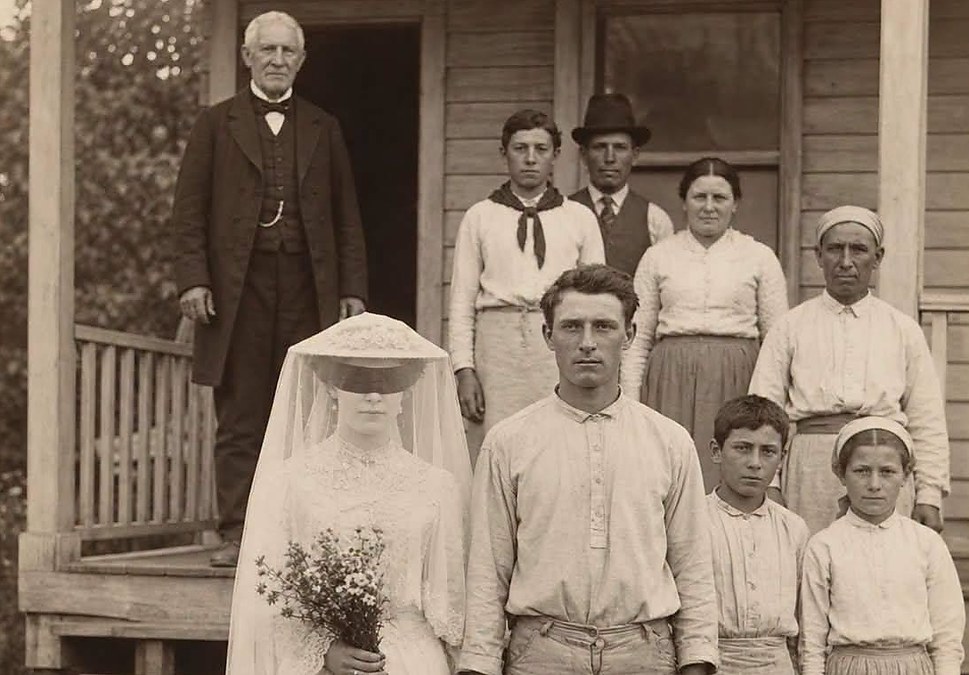
Her father never offered her choices. The following day, she was married in a rushed, simple ceremony. She never saw his face, of course — and nobody described it to her.
Her father pushed her toward the man and ordered her to take his arm. She obeyed like a ghost trapped in her own body. People laughed behind their hands.
“The blind girl and the beggar.”
After the ceremony, her father gave her a small bag with a few clothes and shoved her toward the man once more. “She’s your burden now,” he said, walking away without looking back. The beggar, whose name was Yusha, guided her silently down the road.
He didn’t speak for quite some time. They reached a broken little hut at the edge of the village. It smelled like damp earth and smoke.
“It isn’t much,” Yusha said softly. “But you’ll be safe here.” She sat on the worn mat inside, fighting back tears. This was her life now — a blind girl married to a beggar, living in a hut built from mud and fragile hope.
But something unusual happened that very first night.
Yusha prepared her tea with careful, gentle hands. He gave her his own blanket and slept beside the door, like a guard dog protecting his queen. He spoke to her as though she mattered — asking which stories she liked, what dreams she had, what foods made her happy.
No one had ever asked her such questions before.
Days became weeks. Every morning, Yusha led her to the river, describing the sunlight, the birds, the trees with such poetry that she started to feel as if she could see them through his words. He sang to her while washing clothes and shared stories about stars and faraway lands at night.
She laughed for the first time in years. Her heart gradually began to open. And inside that strange little hut, something incredible happened — Zainab fell in love.
One afternoon, as she reached out for his hand, she asked quietly: “Were you always a beggar?” He paused. Then replied softly, “Not always.” But he said nothing else. And she didn’t question him.
Until one day. She went to the market by herself to buy
vegetables. Yusha had given her precise instructions, and she memorized each step.
But halfway there, someone violently grabbed her arm.
“Blind rat!” a voice hissed. It was her sister. Aminah.
“You’re still alive? Still pretending to be a wife to a beggar?” Zainab felt tears forming, but she stood tall. “I’m happy,” she replied.
Aminah laughed bitterly. “You don’t even know who he is. He’s worthless.
Exactly like you.” Then she whispered something that broke her. “He isn’t a beggar, Zainab. You were deceived.” Zainab stumbled home, confused and terrified.
She waited until nightfall, and when Yusha came back, she asked again — this time firmly. “Tell me the truth. Who are you really?” That was when he knelt before her, held her hands, and said: “You were never meant to know yet.
But I can’t keep lying to you.” Her heart raced. What comes next changes everything…
Zainab’s life is sold in a single sentence. No questions. No mercy.
Just a father’s command and a stranger’s name. On her wedding day,
she walks like a prisoner toward a future chosen by everyone but her. Yet in the quiet of that unwanted marriage, something impossible begins to brea… Continues…
Zainab enters Yusha’s home expecting another prison, bracing herself for the same anger and control that ruled her childhood. Instead, she finds a man who steps back rather than forward, who listens more than he speaks, and who never treats her fear as an inconvenience. His gentleness unsettles her at first; it contradicts everything she has been taught about power, duty, and what a daughter or wife owes to the men in her life.
Day by day, her silence loosens. She tests small freedoms: an opinion offered, a boundary voiced, a memory shared without being dismissed. Yusha’s steady respect becomes the quiet ground on which she learns to stand.
Their marriage, once a symbol of her powerlessness, slowly transforms into a partnership where both are allowed to be vulnerable. In choosing kindness over control, they remake not only their home, but Zainab’s belief in her own worth.