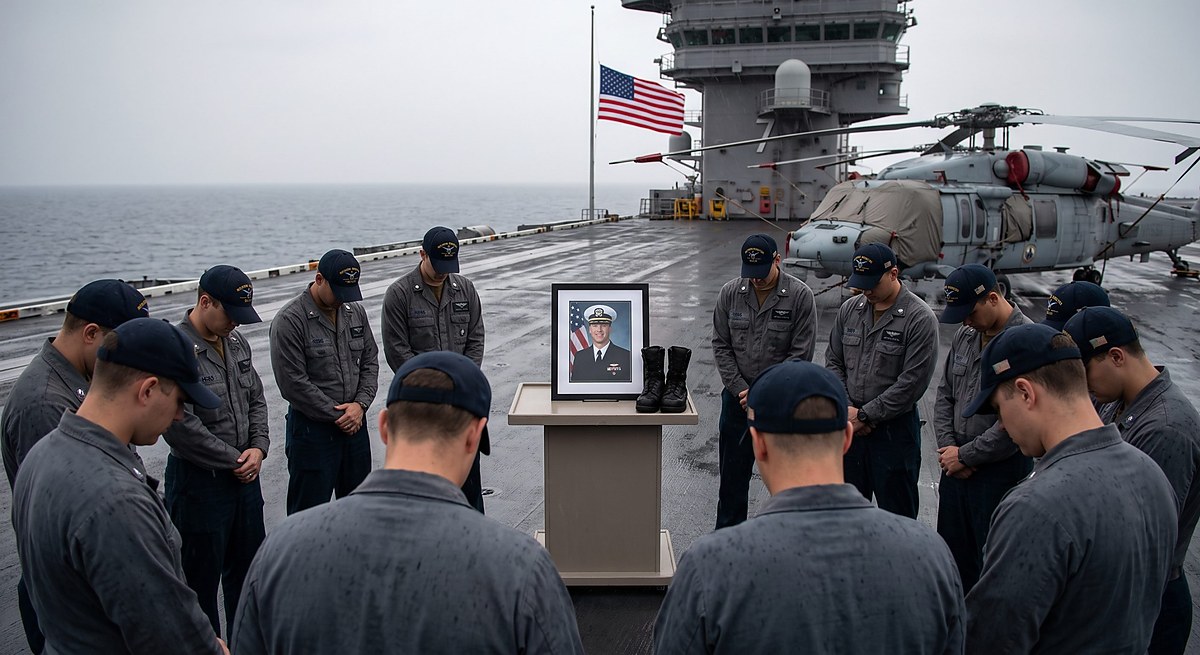
The Navy subsequently identified the lost officer as Commander Gabriel…
MANAMA, Bahrain — The U. S. Navy has officially suspended a massive, relentless search and rescue operation for a senior naval aviator declared missing after his MH-60S Sea Hawk helicopter executed an emergency landing in the open waters of the Arabian Sea earlier this week. The decision on July 5 ends more than 102 continuous
hours of a high-stakes, multinational effort that scrubbed a staggering 14,000 square miles of volatile ocean. The operation mobilized a powerful array of surface ships, guided-missile destroyers, helicopters, long-range maritime patrol aircraft from both the Navy and U. S. Air Force, and coordinates across multiple carrier strike groups. The helicopter, assigned to the aircraft carrier
USS George H. W. Bush (CVN 77), was conducting routine operations in the U. S. 5th Fleet area of operations when the emergency occurred at approximately 3:30 a. m. Eastern time on July 1. Of the four crew members aboard, three were swiftly rescued and returned to the Bush in stable condition. The relentless focus
of subsequent operations, however, was dedicated entirely to locating the fourth crew member.
The Navy subsequently identified the lost officer as Commander Gabriel Edwards, the
widely respected Commanding Officer of Helicopter Sea Combat Squadron (HSC) 5, the “Nightdippers.”
The service later announced that Edwards, a seasoned veteran, has been posthumously promoted to the rank of Captain. Navy officials and his family remembered him as both a dedicated leader and a devoted husband and father. A Multilayered, Brutal Challenge The suspension of the search on July 5 underscores the severe operational complexity of locating
a lone survivor in one of the world’s most demanding environments. Under the tactical coordination of the USS George H. W. Bush, the search grid was massive. Units from the USS Abraham Lincoln Carrier Strike Group joined the effort, alongside specialized Arleigh Burke-class destroyers and the P-8 Poseidon maritime patrol aircraft. The Poseidon, a sensor-rich
platform designed for long-range surveillance, flew repeated sorties, utilizing advanced radar and electro-optical sensors to scan thousands of square miles. Despite this total saturation of naval capability, search crews were unable to find any trace of Captain Edwards. For the Navy, the active search phase—the intensive, life-saving race against time—concluded at approximately 3 p. m.
Arabian Standard Time on July 5. Investigation and Context
The operational focus now shifts from rescue to investigation. A comprehensive Navy
investigation into the circumstances surrounding the emergency landing is already underway. While the precise cause has not been publicly established, Navy officials emphasized that there is “no indication” of hostile action. The focus of investigators will be broad, examining airframe performance, maintenance records, crew procedures, environmental conditions, and the final moments before the Sea Hawk
was forced down. The incident occurred as the USS George H. W. Bush Strike Group was deployed to the vital Central Command region during a window of significant regional military activity. However, no public evidence has established any correlation between the operational environment and the helicopter emergency. While the intense search has been suspended, the
incident investigation continues. For the Navy, this is the start of a meticulous process to prevent future tragedies. For the family and shipmates of Captain Edwards, it is the beginning of a profound mourning, honoring a leader lost to the immense, unforgiving wilderness of the open ocean.